Hi everyone! 🙂
Today I need to look at choosing the right cooking fats and oils to add to my daily cooking essentials.
Have you had any doubts when choosing the right ones?
I had many times….:)
As usual, I need to do some researches before adding them to my list.
Today I would like to share with you simple guide how to select the right ones.
We need to remember to avoid eating bad fats and oils to protect our pancreas and liver which are responsible for digesting fats.
Fats are divided in to three types:
Saturated Fats :
These are generally solid at room temperature and linked to increasing levels of total and LDL or bad cholesterol in the blood and the risk of heart disease.
FIND THEM IN:
- fatty meat
• chicken skin
• processed meat
• ice cream
• palm oil
• ghee
• cooking/baking margarine
• deep-fried foods
• baked goods (such as cakes, pastries, pies and biscuits)
Polyunsaturated fats
These tend to be liquid at room temperature and may help to lower total and LDL cholesterol (but may also lower HDL or good cholesterol). They can be divided into two groups – omega-3 and omega-6. Both are important for heart health but omega-3s also help to reduce inflammation and are important for cognitive functions.
FIND THEM IN:
• sunflower oil, seeds and spread
• flaxseed (linseed) oil and seeds
• sunflower oil
• maize oil
• corn oil
• sesame oil
• soybean oil and soya spread
• pumpkin seeds
• sesame seeds
• walnuts
• pine nuts
• brazil nuts
Monounsaturated fats
These are also usually liquid at room temperature. Health experts agree they’re the healthiest type as they can help to lower total and LDL cholesterol, also maintain levels of HDL or good cholesterol, making them a great choice for a healthy heart.
FIND THEM IN:
• olives
• olive oil and olive-based spread
• rapeseed oil and spread
• avocados and avocado oil
• peanuts, peanut oil and peanut butter
To simplify my choice I always check the label and choose these with less than 4grams of saturated fat per tablespoon.
Another point to consider is choosing right fat for cooking in high temperature.
My winner is coconut oil
Now it is time to choose proper oil to make salad dressing.
The winner is extra virgin olive oil
Olive oil lowers blood pressure, protects LDL particles from oxidation, reduces inflammation and may help prevent unwanted blood clotting.
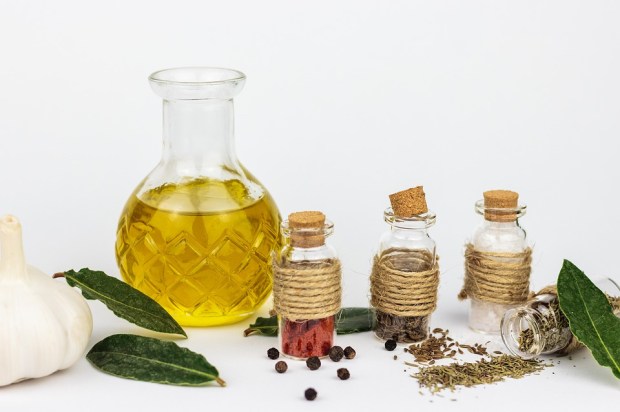
You can also make your own herbs or spices infused oil.
Use oil dispenser bottles
My other ‘essential’ oil is Flaxseed oil.
Flaxseed oil is high in ALA omega-3 fatty acids, which have been associated with numerous health benefits. Some test-tube and animal studies show that flaxseed oil may reduce cancer cell growth, although additional research in humans is needed. Flaxseed oil could improve heart health by reducing blood pressure and increasing the elasticity of the arteries. It may help treat both constipation and diarrhea. Flaxseed oil may have anti-inflammatory properties.
What’s more… flaxseed oil
Including just one or two servings of flaxseed oil in your daily routine is easy and could have numerous benefits for your overall health. It is used in Dr. J Budwig’s Protocol.
Keep in mind that flaxseed oil should not be used for cooking, as it does not have a high smoke point and can form harmful compounds when exposed to high temperature!
 Healthy Lifestyle & Habits